Category Archives: Society News

Congratulations to our new Honorary Members, Miriam Marmontel and Barb Taylor

Dear Members of the Society for Marine Mammalogy,

I am thrilled to announce that both Miriam Marmontel and Barbara Taylor have been selected as honorary members of the Society for Marine Mammalogy. This prestigious honour is a testament to their unparalleled dedication, significant contributions, and profound impact on the field of marine mammalogy, and I would like to extend my warmest congratulations to Miriam and Barbara.

Miriam and Barbara have exemplified excellence in their respective roles, pioneering advancements in research, conservation, and education related to marine mammalogy. Their unwavering commitment to understanding and protecting marine mammals has not only enriched our scientific community but has also inspired countless individuals to follow in their footsteps.

As honorary members, Miriam and Barbara join an esteemed cohort of individuals whose passion and expertise have shaped the course of marine mammalogy and paved the way for a deeper understanding of these fascinating creatures. Their induction as honorary members underscores their significant contributions to our society and reinforces our collective commitment to advancing the field of marine mammalogy.

Please join me in congratulating Miriam and Barbara on this well-deserved honour. We look forward to celebrating their achievements and continued impact within our society and beyond.

Katharina J. Peters
Chair, Nominations & Elections Committee

SMM Editors’ Select Series Webinar, 15 February 2024: Foraging migration ontogeny in southern elephant seals with Dr. Trevor McIntyre

You are invited to the next edition of the SMM Editors’ Select Webinar Series. This series highlights the latest and most exciting marine mammal science published in the Marine Mammal Science Journal. The SMM created this series to give scientists and citizens around the world a chance to engage with marine mammal scientists, learn, and ask questions. All are welcome!

Join us on Thursday February 15th 2024 at 10 am PST / 6 pm GMT
for the next SMM Editors’ Select Series Webinar:
Foraging migration ontogeny in southern elephant seals: finding their way as they go?
with Dr. Trevor McIntyre

This event was recorded live and put on youtube: https://youtu.be/z5idHO-KHvg
For future events, please check our news room or join the SMM Facebook page.

About this talk:
Elephant seal pups are abandoned by their mothers when they are between three and four weeks of age. After a short period of fasting on-land, they depart on their first foraging migrations unaccompanied by adults. These maiden foraging trips normally last longer than three months, during which they must avoid potential predators such as orcas and find sufficient food in the vast Southern Ocean. The development of the skills needed to successfully navigate these early foraging trips is poorly understood, not only in elephant seals, but in many animals that perform extreme migratory behaviours. We studied the maiden foraging trips of recently weaned southern elephant seal pups from Marion Island ̶ a small, but intensively studied population located in the southern Indian Ocean. Unlike the adults of this population, recently weaned pups did not show evidence of consistency in travel directions, distances and speed of travel between individuals, or even between sequential foraging trips by the same individuals. Cumulatively, our results suggest that the foraging strategies of adult elephant seals from this population are strongly influenced by rapid learning while at-sea and is likely less reliant on innate behaviours or innate responses to large-scale environmental cues. There remains a need for continued longitudinal studies to better understand what the likely population-level effects of juvenile behavioural strategies are.

About the presenter:
Dr Trevor McIntyre is an Associate Professor in Zoology at the University of South Africa (UNISA). He first started working with marine mammals as a field assistant on the Marion Island Marine Mammal Programme in 2005, before continuing with his PhD studies on at-sea behaviours of southern elephant seals at the University of Pretoria. Dr McIntyre then commenced  a few years of postdoctoral research in South Africa and at the Alfred Wegener Institute in Germany, followed by a lecturing position at the University of KwaZulu-Natal, before joining UNISA in 2019. His broad research interests are centred around behavioural adaptations of animals to environmental change, particularly for semi-aquatic mammals such as seals and otters. Current research projects he is involved in include studies on the ecology of African clawless otter in freshwater systems of South Africa and Ross seals in the eastern Weddell Sea, Antarctica.

Open access to this article is made temporarily available in the weeks around the presentation and can be found here. Current SMM members have access to all Marine Mammal Science papers.

Missed a presentation or want to share this series with a friend? All previous Editors’ Select presentations are recorded and archived on our YouTube channel here.

Application Deadline for the Louis M Herman Research Scholarship

Louis M. Herman, Ph.D. and Emeritus Professor at the University of Hawaii at Manoa, will always be remembered for his innovative, creative, and scientifically rigorous approach to the study of the marine mammals he so loved, and for the future generations of marine mammal researchers he and his work continue to inspire. The Louis M. Herman Research Scholarship supports research projects that contribute to our understanding of either cetacean cognition and sensory perception (laboratory or field studies), or humpback whale behavioural ecology or communication. Work with other marine mammals that especially enhances our understanding of their cognitive abilities will also be considered. Eligible candidates include graduate students and those students who have completed their Masters or PhD within the past three years and are members of the Society of Marine Mammalogy. Full details of application submission materials and criteria can be found on the Society for Marine Mammalogy webpage.

Submission deadline is Monday, 5 February 2024 (10pm, Hawaii-Aleutian Standard Time GMT-10 hours) 

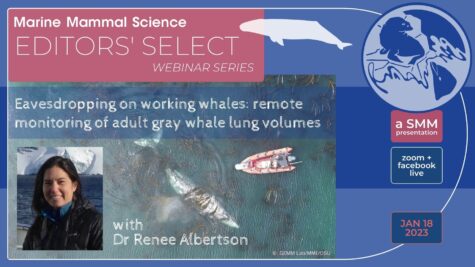
SMM Editors’ Select Series Webinar, 18 January 2024: Eavesdropping on working whales, with Dr. Renee Albertson

You are invited to the next edition of the SMM Editors’ Select Webinar Series. This series highlights the latest and most exciting marine mammal science published in the Marine Mammal Science Journal. The SMM created this series to give scientists and citizens around the world a chance to engage with marine mammal scientists, learn, and ask questions. All are welcome!
 
Join us on Thursday January 18th 2024 at 1 pm PST / 9 pm GMT
for the next SMM Editors’ Select Series Webinar:
Eavesdropping on working whales: remote monitoring of adult gray whale lung volumes
with Dr. Renee Albertson
 

This event was recorded live and put on youtube: https://youtu.be/aEOnLXq390Q
For future events, please check our news room or join the SMM Facebook page.

 
About this talk:
Understanding how a species’ metabolic rate varies in different behavioral contexts is useful for quantifying prey requirements and foraging efficiencies of individuals. Field metabolic rates (FMR) are daily estimates of oxygen consumption, which depend on three factors: lung capacity, breathing rate, and the amount of oxygen extracted from the air. This study describes a novel approach to estimating tidal lung volumes (VT) of actively foraging adult gray whales and compares those to VT estimates of gray whales studied in a winter breeding/calving lagoon. An unoccupied aircraft system (UAS) along the central Oregon coast monitored foraging whales from 2016-2020. Breathing patterns of gray whales typically include very rapid exhalation/inhalation events as they surface, followed by submerged breath holds of varying duration and depth. UAS video and acoustic recordings revealed that foraging whales have 35-40% higher mass-relative VT values than resting lagoon females. This reflects differences in behavior, activity levels, and oxygen needs between the two groups.
The tidal lung volumes of fasting lagoon whales and foraging whales fall between that of resting terrestrial mammals and small to medium-sized odontocetes. The methods described here, especially the use of UASs for measuring body lengths and breathing rates, provide a new tool for estimating gray whale oxygen consumption and energy requirements.
 
About the presenter:
Dr. Renee Albertson is a teaching professor and research affiliate at Oregon State University, where her current research focuses on gray whale physiology. In collaboration with multiple scientists within the university’s Marine Mammal Institute, she has been studying gray whale metabolic rates and aerobic dive limits, including the research she will share today. Dr. Albertson earned BS degrees in Chemistry and Biochemistry and a MA in Teaching from Pacific University in 1994 and 1997, and taught high school chemistry from 1997 to 2007. She began her career in marine mammal science in 2005, when she completed an intensive internship in Moorea, French Polynesia working on photo-identification of small cetaceans and humpback whales. She went on to complete her MSc and PhD degrees at Oregon State University with Dr. Scott Baker, where she used genetic markers and photo identification to study migratory patterns and abundance of South Pacific humpback whales and phylogeographic patterns and taxonomic and social structures of rough-toothed dolphins. After completing her PhD in 2014 she worked as a postdoctoral scholar for Dr. Ari Friedlaender, where she evaluated changes in humpback whale migration and fine-scale population structure in the Western Antarctic Peninsula, one of the fastest warming areas on the planet. Today, in addition to her research, she teaches several field-based marine mammal courses at Oregon State University and continues to collaborate with scientists and policy makers in the South Pacific.
 
Open access to this article is made temporarily available in the weeks around the presentation and can be found here. Current SMM members have access to all Marine Mammal Science papers.
 
Missed a presentation or want to share this series with a friend? All previous Editors’ Select presentations are recorded and archived on our YouTube channel here.

Vote for SMM’s 2024 Honorary Member(s)

Dear Members,

This is your reminder to vote for SMM’s Honorary Member nominees by 30 January 2024.

We are pleased to present two new nominees to become Honorary Members for you to vote on. An Honorary Member is a member recognized for distinguished service to the field of marine mammalogy, as recommended unanimously by the Board of Governors, and elected by two-thirds of the voting members. Honorary Members have all the privileges of full members but are exempt from dues.

Here is the link to the ballot: https://marinemammalscience.org/for-members/2023-members-ballot/

The ballot will close at 3:00 PM EST on 30 January 2024.

Best wishes,
Katharina J. Peters
Nominations and Elections Committee Chair

Deadline to Nominate an SMM Fellow is 15 January 2024

NOMINATE A FELLOW MEMBER
In 2019, the members of the Society for Marine Mammalogy (SMM) voted to establish a Fellows Membership Category. We are pleased to announce our Society’s second call for nominations of Fellow Members.

The SMM Constitution identifies a ‘Fellow’ as a member who is being recognized by the Society and its membership as having “rendered conspicuous service or made truly notable contributions to the advancement and diffusion of the knowledge of marine mammal science or the fostering of its practical applications through conservation of marine mammals. Payment of dues to the Society by the Fellow would remain the same as for a normal Full member.”

Nominations are Open.
The deadline to nominate a fellow is 15 January 2024. So please come nominate a Fellow for the Society.

ELIGIBILITY
Any current Full member of the SMM after being a Full member for a minimum of five years is eligible. These five years do not have to be contiguous. Please confirm with the nominee that they meet the five-year eligibility criterion prior to submission.

Note: the current members of the SMM Board (which includes elected officers and committee chairs) are not eligible for consideration for Fellows status.

HOW TO NOMINATE
If you are a current SMM member, you may nominate an eligible SMM member as a Fellow. We ask that you submit a complete dossier, described in detail below, to the Fellows Nomination web page by 15 January 2024. The dossier must be uploaded to the Fellows Nomination web page as a single .pdf document.

Each dossier shall include the following elements.

(1) Letter of Nomination. This letter should provide insight into a nominee’s service, notable contributions to the advancement and diffusion of the knowledge of marine mammal science, or the fostering of its practical applications through the conservation of marine mammals. The nominating letter can be no longer than one page (12 pt font).
The Committee will consider the following factors:

  1. service to the Society;
  2. contributions to marine mammal science including activities such as publications and presentations, field work, research and development, or administrative and logistical support; or
  3. contributions to the teaching or dissemination of knowledge of marine mammal science and conservation. Due to the diversity of disciplines and activities of The Society for Marine Mammalogy members, the relative importance of these factors will differ from candidate to candidate. The Fellow candidate would be expected to be exemplary in, and have made substantial contributions to, at least one of these factors (e.g. be in the top 10% of the membership).

(2) Seconding letters. The dossier should also include two seconding letters, one of which must be from a current SMM member. Signed-in SMM members can search for all current members via the SMM Member Directory. Each seconding letter can be no longer than one page (12 pt font).

(3) Complete curriculum vitae of the nominee. The format and length of this document is unrestricted, as we are encouraging nominations of individuals from broadly different backgrounds and the standard CV formats across fields are likely different. Note that only text should be submitted as part of the CV. If audio or video files are relevant provide a link in the documents submitted.

(4) Proposed maximum 20-word citation for the Fellow (e.g., Kenneth S. Norris – for efforts to found the Society and contributions to the process of dolphin echolocation and hearing).

All materials must be uploaded here: https://marinemammalscience.org/about-us/fellows-program/fellows-program-nomination/

DOSSIER REVIEW PROCESS
The dossiers will be received by the committee Co-chairs and the SMM Members-at-Large.

Identifying information about the nominator and seconders will be redacted from each dossier to ensure a blind review. The Fellows Committees will be Co-Chaired by the Members-at-Large, who will form a committee of seven members holding Fellow status, and at least one contributing, but not voting student member, with attention paid to diversity of representation. Members will serve staggered, four-year terms. Fellows Committee members may not submit nominations. For more information about the Fellows Committee, please see the General Operating Policies of our SMM governing documents.

QUESTIONS
If you have any questions about the nomination process, please reach out to the Co-Chairs of the Fellows Committee, our Members-at-Large:
Cindy Peter and Dipani Sutaria (mal@marinemammalscience.org)
For any technical questions regarding the online application, please email admin@marinemammalscience.org.

Thank you,
Members-at-Large 2023
Society of Marine Mammalogy

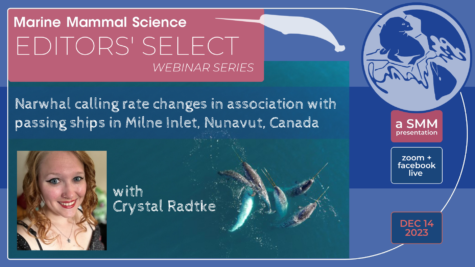
SMM Editors’ Select Series Webinar, 14 December 2023: Calling rate changes in association with passing ships in Milne Inlet, Nunavut, Canada, with Crystal Radtke

You are invited to the next edition of the SMM Editors’ Select Webinar Series. This series highlights the latest and most exciting marine mammal science published in the Marine Mammal Science Journal. The SMM created this series to give scientists and citizens around the world a chance to engage with marine mammal scientists, learn, and ask questions. All are welcome!

Join us on Thursday December 14th 2023 at 5 pm AST / 9 pm GMT
for the next SMM Editors’ Select Series Webinar:
Narwhal calling rate changes in association with passing ships in Milne Inlet, Nunavut, Canada
with Crystal Radtke

This event was recorded live and put on youtube: youtu.be/kYpoMpsdrTU 
For future events, please check our news room or join the SMM Facebook page.

About this talk:
Concerns were raised about possible behavioural disturbance to narwhals (Monodon monoceros) when exposed to shipping noise in Milne Inlet, Baffin Island, Nunavut, Canada. It is known that marine mammals often change their behaviours especially their vocalizations, around ships.  With the use of underwater recordings operating continuously over two months (in 2018 and 2019), narwhal vocalizations in Milne Inlet were analyzed. Narwhals produce three social call types, whistles, buzzes and knocks. The calling rates of each call type were determined when no ships were present and during ship transits in a before-during-after analysis. Narwhal call counts were generally lower when bulk carriers were within line-of-sight (5 km), including when ship noise levels were barely above background noise levels. Call counts varied both “before” and “after” individual bulk carriers passed by the recorders. There was no evidence of habituation or sensitization to the bulk carrier noise within or between years. Continued monitoring in this area is recommended, especially if shipping levels increase.

About the presenter:
Crystal studied at the University of New Brunswick, in Saint John, NB, Canada for undergraduate and graduate studies. Her honours project was on the underwater soundscape of Mawson Station, Antarctica and the impacts this could have on the masking of Weddell seal calls.  Her masters thesis was on the classification of narwhal calls and the changes in calling rates in association with passing ships. She has also volunteered with various organizations (Bimini Biological Field Station, Dolphin Communication Project and Operation Wallacea) for marine mammal, fish and marine invertebrate studies.

Open access to this article is made temporarily available in the weeks around the presentation and can be found here. Current SMM members have access to all Marine Mammal Science papers.

Missed a presentation or want to share this series with a friend? All previous Editors’ Select presentations are recorded and archived on our YouTube channel here.

Louis M. Herman Research Scholarship: Open for Proposals

Louis M. Herman, Ph.D. and Emeritus Professor at the University of Hawaii at Manoa, USA, was a pioneer and trailblazer in research on dolphin sensory perception and cognition, and humpback whale behavioural ecology. Dr. Herman’s family, colleagues, and friends established the Louis M. Herman Research Scholarship in 2017 to honor his legacy by promoting the type of research that was the focus of his ground-breaking studies. The Scholarship is given every two years and is open for application today (November 27 2023). The 2024 award will be for USD $6,000. Eligibility criteria and the application process is available here  


Please direct any enquiries to the Awards and Scholarship Sub-Committee (awardschair@marinemammalscience.org)

Nominate a SMM Member to be a Fellow for the Class of 2023

Announcement and Date extension

NOMINATE A FELLOW MEMBER
In 2019, the members of the Society for Marine Mammalogy (SMM) voted to establish a Fellows Membership Category. We are pleased to announce our Society’s second call for nominations of Fellow Members.

The SMM Constitution identifies a ‘Fellow’ as a member who is being recognized by the Society and its membership as having “rendered conspicuous service or made truly notable contributions to the advancement and diffusion of the knowledge of marine mammal science or the fostering of its practical applications through conservation of marine mammals. Payment of dues to the Society by the Fellow would remain the same as for a normal Full member.”

Nominations are Open.
We are pleased to announce that the nomination period is extended until 15 January 2024. So please come nominate a Fellow for the Society.

ELIGIBILITY
Any current Full member of the SMM after being a Full member for a minimum of five years is eligible. These five years do not have to be contiguous. Please confirm with the nominee that they meet the five-year eligibility criterion prior to submission.

Note: the current members of the SMM Board (which includes elected officers and committee chairs) are not eligible for consideration for Fellows status.

HOW TO NOMINATE
If you are a current SMM member, you may nominate an eligible SMM member as a Fellow. We ask that you submit a complete dossier, described in detail below, to the Fellows Nomination web page by 15 January 2024. The dossier must be uploaded to the Fellows Nomination web page as a single .pdf document.

Each dossier shall include the following elements.

(1) Letter of Nomination. This letter should provide insight into a nominee’s service, notable contributions to the advancement and diffusion of the knowledge of marine mammal science, or the fostering of its practical applications through the conservation of marine mammals. The nominating letter can be no longer than one page (12 pt font).
The Committee will consider the following factors:

  1. service to the Society;
  2. contributions to marine mammal science including activities such as publications and presentations, field work, research and development, or administrative and logistical support; or
  3. contributions to the teaching or dissemination of knowledge of marine mammal science and conservation. Due to the diversity of disciplines and activities of The Society for Marine Mammalogy members, the relative importance of these factors will differ from candidate to candidate. The Fellow candidate would be expected to be exemplary in, and have made substantial contributions to, at least one of these factors (e.g. be in the top 10% of the membership).

(2) Seconding letters. The dossier should also include two seconding letters, one of which must be from a current SMM member. Signed-in SMM members can search for all current members via the SMM Member Directory. Each seconding letter can be no longer than one page (12 pt font).

(3) Complete curriculum vitae of the nominee. The format and length of this document is unrestricted, as we are encouraging nominations of individuals from broadly different backgrounds and the standard CV formats across fields are likely different. Note that only text should be submitted as part of the CV. If audio or video files are relevant provide a link in the documents submitted.

(4) Proposed maximum 20-word citation for the Fellow (e.g., Kenneth S. Norris – for efforts to found the Society and contributions to the process of dolphin echolocation and hearing).

All materials must be uploaded here: https://marinemammalscience.org/about-us/fellows-program/fellows-program-nomination/

DOSSIER REVIEW PROCESS
The dossiers will be received by the committee Co-chairs and the SMM Members-at-Large.

Identifying information about the nominator and seconders will be redacted from each dossier to ensure a blind review. The Fellows Committees will be Co-Chaired by the Members-at-Large, who will form a committee of seven members holding Fellow status, and at least one contributing, but not voting student member, with attention paid to diversity of representation. Members will serve staggered, four-year terms. Fellows Committee members may not submit nominations. For more information about the Fellows Committee, please see the General Operating Policies of our SMM governing documents.

QUESTIONS
If you have any questions about the nomination process, please reach out to the Co-Chairs of the Fellows Committee, our Members-at-Large:
Cindy Peter and Dipani Sutaria (mal@marinemammalscience.org)
For any technical questions regarding the online application, please email admin@marinemammalscience.org.

Thank you,
Members-at-Large 2023
Society of Marine Mammalogy

SMM Editors’ Select Series Webinar, 19 October 2023. Genetically separate populations of dugongs in Australia, with Dr. Janet Lanyon


You are invited to the next edition of the SMM Editors’ Select Webinar Series. This series highlights the latest and most exciting marine mammal science published in the Marine Mammal Science Journal. The SMM created this series to give scientists and citizens around the world a chance to engage with marine mammal scientists, learn, and ask questions. All are welcome!

Join us on Thursday, 19 October 2023 at 5pm EDT / 10pm GMT / 7am +1 AEST
for the next SMM Editors’ Select Series Webinar:
Genetically separate populations of dugongs in Australia:
implications for coping with local environmental stressors
with Dr. 
Janet Lanyon

This event was recorded live and put on youtube: youtu.be/PpUeaEFK5eY 
For future events, please check our news room or join the SMM Facebook page.

About this talk:
Despite the lack of obvious physical barriers and their ability to travel significant distances, many marine mammals exhibit substantial population structuring over relatively short geographical distances. The dugong (Dugong dugon) is a vulnerable marine mammal found in inshore seagrass habitats throughout the Indo-Pacific, including in the waters of northern Australia. We investigated the genetic population structure of dugongs in the shallow coastal waters along >2000 km of the eastern Queensland coast including the Great Barrier Reef region. Microsatellite genotypes for 22 loci in 293 dugongs, SNP genotypes based on 10,690 loci in 43 dugongs, and 410 bp mitochondrial control-region sequences from 639 dugongs were analysed. Clustering analysis techniques consistently identified an abrupt genetic break in the Whitsunday Islands region of central Queensland (20.3°S), which interrupts an overall pattern of isolation-by-distance. Geographic distance was relatively more important than sea-surface temperature and seagrass distribution in explaining pairwise microsatellite genetic distances. The cause of reduced dispersal across this region is unknown but might relate to an unusual tidal and current mix, termed the ‘sticky-water’ effect, and/or a break in the geographical distribution of offshore seagrass meadows. This genetic structuring suggests distinct breeding units north and south of the Whitsunday Islands region, and also mostly separate populations with limited gene flow within each of the north and south ranges. Recently, profiles of faecal microbiota from dugongs from all along the Queensland coast show marked variation, supporting these separate populations and possibly indicating ecological differences, e.g., feeding niches. Implications of these separate genetic populations in terms of how dugongs might respond to local threats to habitat and how these findings should be considered when developing management plans for Queensland dugongs will be discussed.

About the presenter:
Janet Lanyon is a zoologist, specializing in marine mammal biology. For thirty years, Janet has been a full-time academic at The University of Queensland (UQ) and Director of the UQ Marine Vertebrate Research Group. Since 1995, she has been Lead Investigator in a long-term population and health study of the dugongs of southern Queensland, Australia. She has published widely on diverse aspects of the biology of marine wildlife, and is an Associate Editor of the journal Marine Mammal Science. Her research expertise includes the ecology, physiology and conservation biology of marine megafaunal wildlife, principally dugongs, coastal dolphins and sea turtles.

Open access to this article is made temporarily available in the weeks around the presentation and can be found here. Current SMM members have access to all Marine Mammal Science papers.

Missed a presentation or want to share this series with a friend? All previous Editors’ Select presentations are recorded and archived on our YouTube channel here.