Later Career: Staying, Adapting, and Asking for More
Authored by members of the Communications Committee: Anaïs Remili, Clare Andvik, and Clarissa Teixeira.
This is the second article in a series exploring the experiences of parents and caregivers in marine mammal science. As noted in Part 1, these responses represent a small, self-selected group , a conversation starter, not a census. The voices here reflect women in mid- to later-career stages who have partners and who have, so far, remained in research. Equally important are the voices not yet captured: those who left, those without structural support, and those for whom staying was not possible. We hope this series creates space for those stories to surface too.
The researchers in this part of the series represent those who have had children later in their career and/or have older children, and the balance between starting a family whilst establishing research groups, mentoring students, publishing, and securing positions, sometimes against significant institutional resistance.
The missed opportunities
By mid-career, the individual moments of sacrifice that defined the early years may start to accumulate: a missed conference, a declined field season, a workshop abroad that was simply not feasible. Each missed opportunity is a collaboration not formed, a job not heard about, a moment of visibility quietly lost. Individually, none of these decisions are career-ending. Collectively, they shape trajectories.
Filipa Samarra, a research centre director in Iceland who finished her PhD in 2011 and has two children aged six and nine, describes the conference problem with particular precision: “I only attend a few conferences, sometimes none per year, which impacts my ability to network and share the research we do.” For a researcher based on a small, remote island, conferences are not an optional extra, they are the primary mechanism for staying connected to a broader scientific community, for building the relationships that generate collaborations and invitations, and for remaining visible to colleagues who make hiring and grant decisions.
Rocio Loizaga, who raised two children while building a research career at Argentina’s National Research Council, with no nearby family, frames the missed opportunities with characteristic directness: “There were times when I couldn’t travel to conferences or participate in long fieldwork expeditions. I also had to miss out on certain workshops and courses. It wasn’t easy, but I had to find other ways to keep my research moving forward.”
Parenthood as a research lens
Many of these researchers describe parenthood as fundamentally reshaping how they think about their science. Not only how they manage their time, but the questions they ask, why those questions feel urgent, and the kind of future they are working toward.
Vanessa Pirotta, a whale ecologist working across academia, government, and private sectors in Australia, describes it as a shift in how she asks questions: “being a mum has opened my eyes up to a whole new world as to how I ask research questions and how I am present for the next generation of scientists.” Clare Andvik, a PhD candidate studying killer whales in Norway, frames the same dynamic from a conservation angle: “I feel even more of a motivation to do what I do now, as I want to protect the oceans and the planet for my children to enjoy. I feel like I have even more at stake because I look at their innocent faces and imagine the world I want for them.” She is careful to acknowledge the shadow side of this: “The bad things feel even more bad and hopeless now, because it’s my children and grandchildren who will suffer.”
Rocio takes this a step further, connecting her own experience of navigating institutional barriers to her philosophy as a mentor and research leader. Having been told, implicitly and explicitly, that her pregnancy was a professional problem, she has built a research environment deliberately designed around the opposite message. “My goal is to mentor the next generation of marine scientists to be not only world-class researchers but also resilient, well-rounded individuals who know that it is possible to pursue their passion for science without sacrificing their passion for their families.”
The mobility trap
If one structural barrier stands out, it is mobility. The conventional academic path, with multiple relocations across countries and institutions, was not designed with caregiving in mind. It assumes, in other words, geographic flexibility, limited personal constraints and often, invisible support systems. For many researchers, this model is no longer sustainable.
Filipa Samarra and her partner made a deliberate choice to relocate to a remote island in Iceland so that she could continue her long-term killer whale fieldwork without spending months away from home each year. “We are still working for a university, but we are based in a small town where the academic environment surrounding us is certainly not as bustling as we were used to.”
The mobility problem also intersects with other pressures that these responses illuminate: the difficulty of building and maintaining a social support network when you move frequently, the impossibility of relying on nearby family when you live across an ocean from your relatives, the challenge of raising children in countries where you don’t speak the language. Filipa writes “It feels like the academic structure is working against parenthood sometimes,” and what she means by “academic structure” includes not just hiring practices and contract lengths, but the entire ecology of assumptions about how a serious researcher lives.
The Maternal Gap
Rocio names something that was widely experienced by all the respondents but is rarely acknowledged: the maternal gap. “When competing for positions or grants, it would
be beneficial to weigh the achievements of women who were raising children during their careers differently. It is inherently more difficult to meet traditional scientific expectations, such as high publication rates, while managing the time and demands of motherhood.”
The maternal gap is not abstract. It is measurable: fewer publications, reduced conference attendance, collaborations become harder to maintain, fewer grants submissions. And not because of reduced ability or commitment. Rather, these gaps reflect competing, unavoidable demands: the researcher has just grown, birthed, and is now feeding a person, while their body recovers, sleep is interrupted, and cognitive resources are divided in entirely new ways. The metrics don’t account for this. They don’t see it. They simply record a gap.
Addressing it requires deliberate institutional adjustment: acknowledging career breaks in grant applications, normalising longer timelines to promotion, evaluating trajectories rather than snapshots, and crucially training the people who make hiring and funding decisions to recognise what a CV with a gap actually represents. Several major funding agencies have made progress on this, introducing provisions for career breaks and recognising parental leave in eligibility calculations. But the gap between policy existence and policy implementation remains wide, and in the absence of a cultural shift in how the gap is perceived, the formal provisions often go unused.
Rocio writes “To be a true ally, we must move beyond ‘equal’ treatment and toward equity. We need to acknowledge the maternal gap in CVs and funding. We must value the immense efficiency and perspective that parents bring to the lab.”
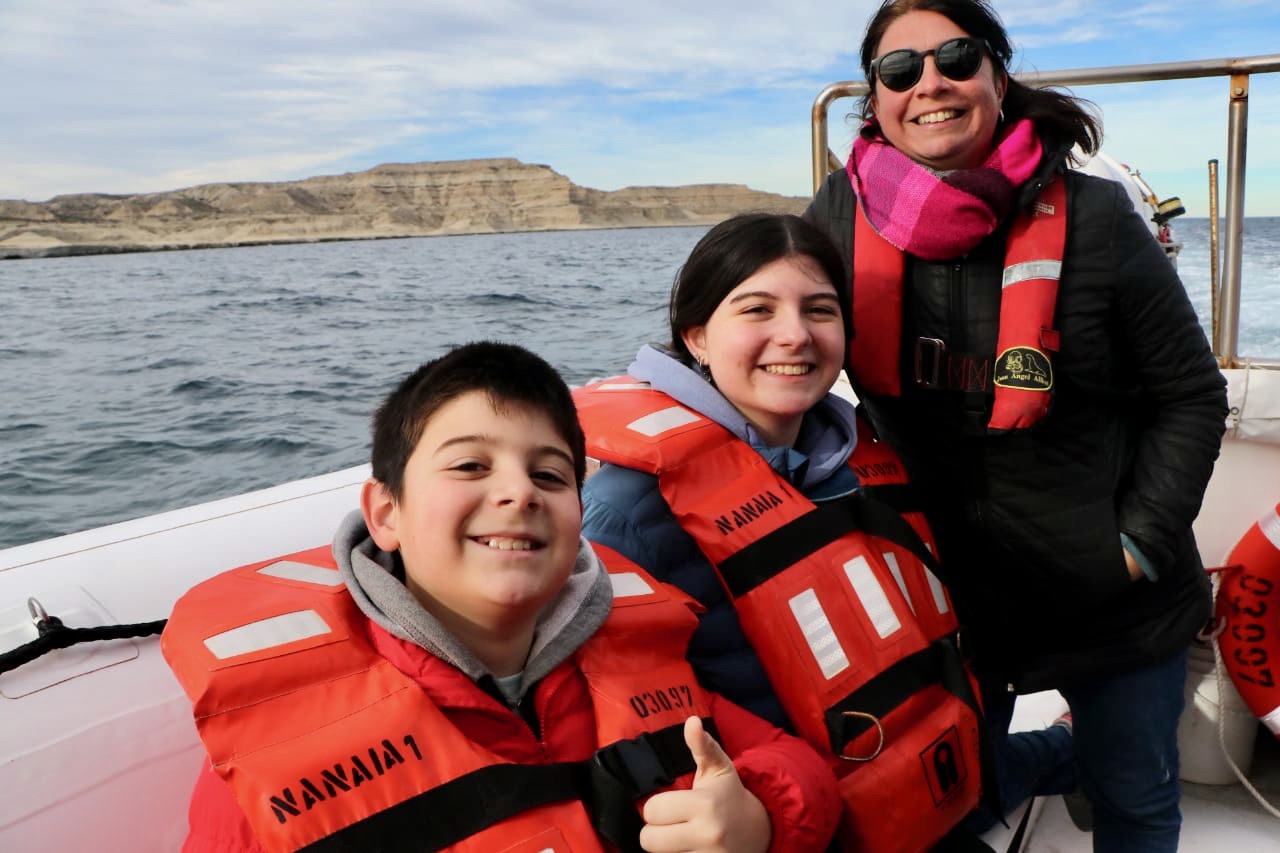 Rocio highlights the “maternal gap” in science, where motherhood creates an unmeasured but very real disparity in academic output and career progression that current evaluation systems often fail to account for — Credit: R. Loizaga
What real support looks like and why it matters
Several respondents pointed to concrete examples of what genuine institutional and community support looks like in practice and the effect it has, both practically and symbolically.
The SMM conference in Perth received unprompted, warm praise from multiple respondents for its provision of family spaces, childcare facilities, and an explicitly welcoming atmosphere for parents with young children. Clare Andvik: “It felt so inclusive. I felt so welcomed as a mother, and my kids loved the toys and spaces available. And it was also so good for the participants to see children enjoying the space, it normalised them being a part of the community. I really encourage more of that for future conferences, it really makes a huge difference.” Filipa Samarra echoes a similar initiative: “Having dedicated rooms for nursing, or daycare, was very helpful.” The practical benefits are real parents who might otherwise not have been able to attend were able to participate. But the symbolic effect may be equally significant. A conference that visibly accommodates families is one that is telling its members, in a concrete and public way, that parents belong here.
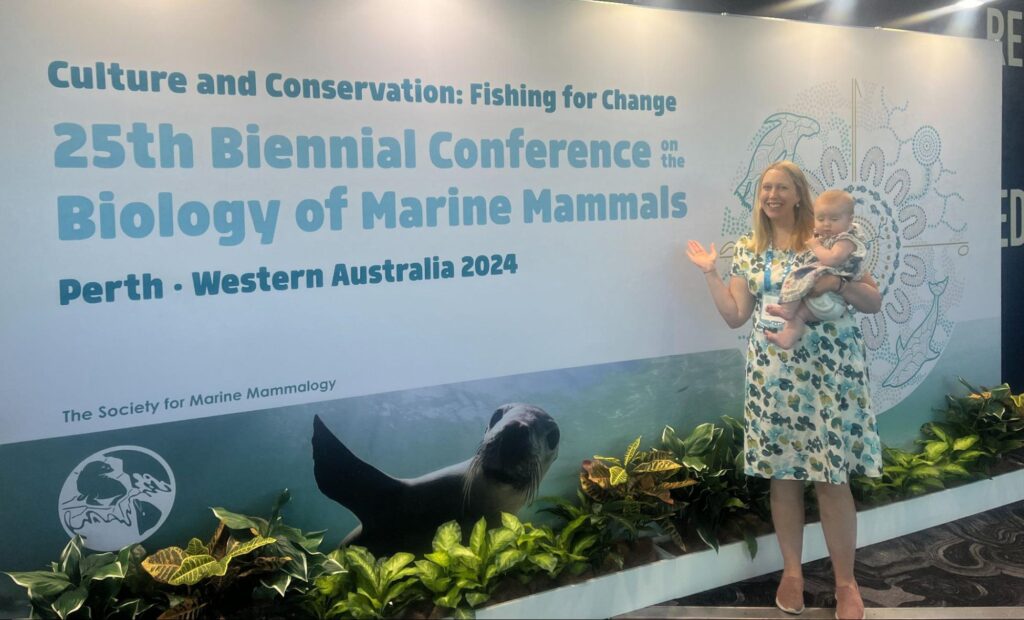
At the SMM Conference in Perth (2024), Clare Andvik attended with her daughter, highlighting how family-friendly spaces and a welcoming atmosphere helped normalise children within the scientific community — Credit: C. Andvik
Hybrid and remote conference options receive equally strong advocacy, particularly from respondents who are geographically isolated or who can only attend one or two in-person events per year. “Of course, we know we miss out on the networking, catching up with friends and colleagues, and all the other advantages that in-person meetings bring,” Filipa acknowledges. “But if at least we can watch the talks, that goes a long way to helping feeling less left out of the latest in the field.”
The support that mattered most to our story-tellers at the individual level was, again and again, partner support. Filipa credits her partner with sharing childcare equally and frames the importance of this for her children in terms that extend well beyond logistics: “It is very important for me that my kids understand that a woman can be a mother and still have a fulfilling career, just like a man can be a father and have a career. That is not the example I saw at home growing up, and so it was particularly important to me that my kids could have a different one.” Rocio identifies her husband’s involvement as “the most definitive factor” in her ability to sustain a career: “Having full support at home both emotionally and logistically made everything manageable. It allowed me to balance the demands of the lab with the needs of my children, ensuring I never had to choose one over the other.”
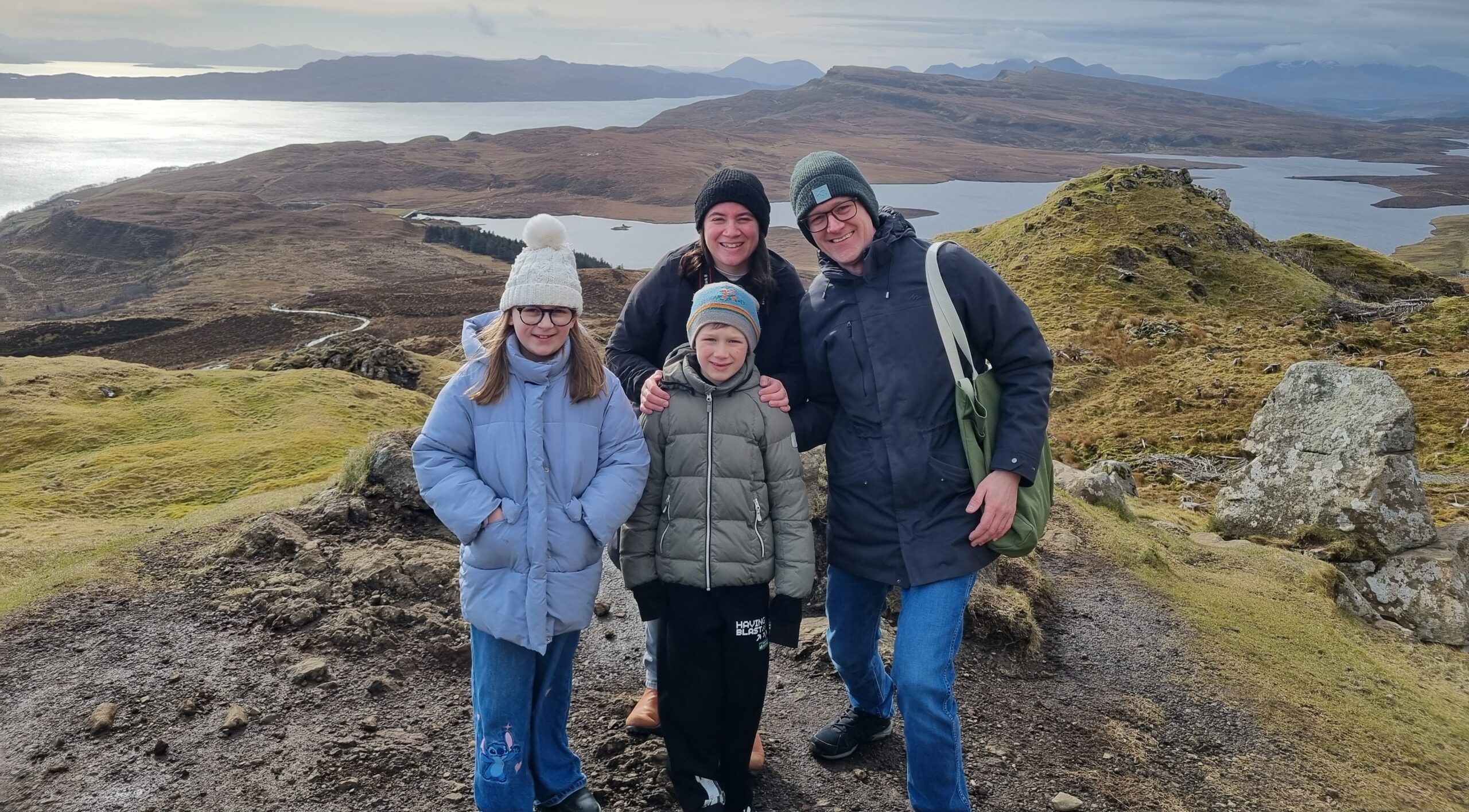 Filipa Samarra and her partner Paul share childcare equally, modeling for their children that both parents can pursue fulfilling careers — Credit: F. Samarra.
Pride, resilience, and the things that sustain you
Amid everything, the structural barriers, the missed opportunities, the mental load, the guilt that several respondents describe as a persistent and unwelcome companion, there are moments of quiet, fierce pride that recur throughout these accounts.
Vanessa describes watching her children — “my calves,” she calls them, with an affection that is both personal and entirely characteristic — call out “humpback whale!” at a northward migration off Sydney. “A true proud moment,” she writes, “and the very reason I study such long-lived animals, so that my legacy lives on across generations.” Chloe Robinson describes photographing killer whales from a research vessel while operating a breast pump, four months after giving birth: “I really felt like I had this whole balance thing down.” Clare did fieldwork in the Arctic winter with a two-month-old daughter in tow, timing the days around feeds. Rocio felt “immensely proud” at every promotion, knowing what it represented,not just professional achievement, but proof that motherhood had not ended her career. Genyffer Troina, a postdoc fellow in British Columbia, states “it is hard, but hang in there, it seems like we are walking in the right direction to make improvements”.
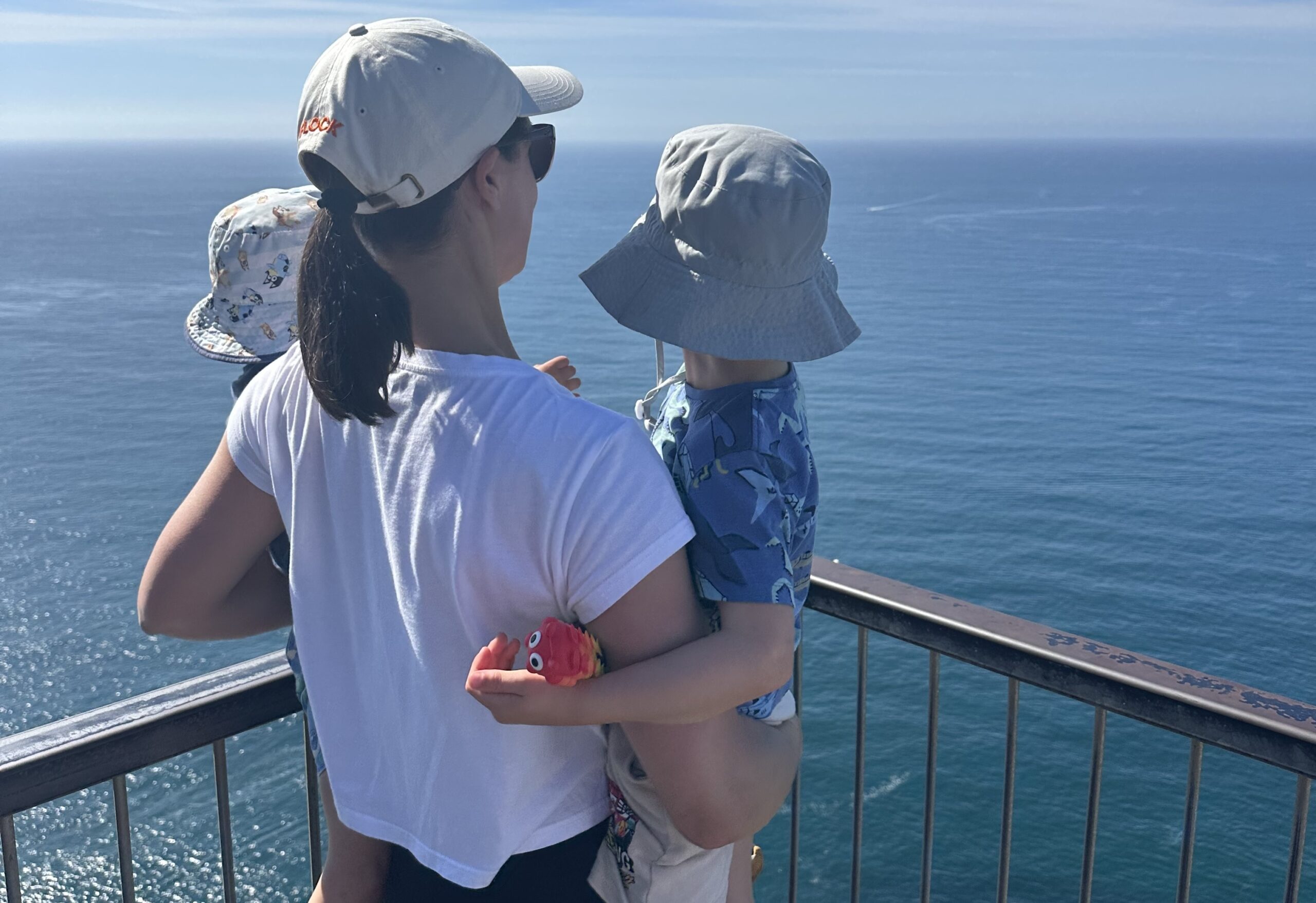 Vanessa Pirotta observing whales from shore with her two “calves” — Credit: V. Pirotta
What our marine mammal society can do
The message our interviewed researchers want to send is not subtle. They are not asking for sympathy or special treatment. They are asking for equity: structural, evaluated, and consistent.
Rocio calls for institutions and funding bodies to formally recognise the maternal gap in evaluation processes. Filipa asks for hybrid conference options and active childcare provision to become standard rather than exceptional. Vanessa asks colleagues and institutions to see parents as “fabulous candidates for opportunities,” not as provisionally committed researchers who need to prove themselves again. Clare, speaking from Norway, wishes the same basic structural support available to her were available everywhere: “I wish all countries and universities were as supportive as Norwegian ones. I feel so angry hearing how PhDs who become mothers are treated in other countries.” Genyffer calls for “research grants aimed for parents, and funding for child-care support for moms who have just graduated and want to look for a new position but can’t afford daycare”.
Gaps in this conversation
This series has so far heard from seven women-identifying individuals, all with supportive partners, all of whom have remained in or near marine mammal research. What it has not heard is equally important and in some ways more so.
The experiences of non-binary parents, fathers and non-birthing partners are absent. There is evidence across the wider literature that fathers who take parental leave or who visibly prioritise caregiving face their own forms of professional penalty and social expectation; those experiences need to be part of this conversation too. The voices of single parents navigating research careers without the domestic and logistical support that every respondent here credits as essential are absent. So are those of researchers caring for parents, siblings, or partners with illness or disability, whose caregiving responsibilities may be less visible but no less demanding. Indigenous researchers face compounded challenges, balancing significant community and kinship responsibilities that remain largely invisible in academic productivity metrics, while working within systems not designed to recognize their knowledge systems. Researchers who had children and left the field, or who chose not to have children partly because of what they observed happening to colleagues who did, are not here. Neither are those from cultural and national contexts much of the Global South, much of Asia, many parts of Europe where the structural, financial, and social challenges of combining parenthood and research take entirely different forms from the Norwegian ideal that several respondents hold up as a model.
These are not peripheral stories. They are central to any honest accounting of what it means to be a caregiver in science. The present responses are offered as an opening, not a conclusion; a small proof that these conversations can happen, and a standing invitation to anyone who has not yet seen their experience reflected here to add their voice.
Please send your stories to communications@marinemammalscience.org
If you feel there are systemic barriers to access, inclusion and equity that should be addressed specifically within our society, please reach out to diversity@marinemammalscience.org.
Further reading
Below are a collection of peer-reviewed studies, and non peer-reviewed articles touching on the themes of this article. We hope it helps in adding weight to these shared experiences.
Gender gaps in academia: The role of children | ScienceDirect
The unequal impact of parenthood in academia | Science Advances
Ten simple rules for a mom-friendly Academia | PLOS Computational Biology
The relationship between parenting engagement and academic performance | PMC
Pregnant women’s brains shed grey matter to prime them for motherhood | BBC / Nature Communications
Single Mothers in Academia Share Best Practices | Spark Magazine
Father’s brain is sensitive to childcare experiences | PNAS
The Native American and Indigenous Studies Association (NAISA) and the Global Indigenous Data Alliance.