Becoming a Parent While Becoming a Scientist
Authored by members of the Communications Committee: Anaïs Remili, Clare Andvik, and Clarissa Teixeira.
This is the first in a series of articles exploring the experiences of parents and caregivers working in marine mammal science. The responses collected here are not a statistically representative sample of the field, nor do they claim to be. They are a starting point, a small but candid set of voices offered to open a conversation that is long overdue in this field. The experiences shared here reflect seven respondents, all women-identifying, and all with partners who share some caregiving responsibilities. But many voices are still missing. Single parents, fathers, non-binary caregivers, those caring for adult dependents, and those without partner support — and we recognize many additional groups not listed here — are not yet represented, and they matter. We hope this series invites them to share their stories too.
There is rarely a convenient time to have a child. In marine mammal science, a field built on long and at times unpredictable fieldwork windows, short-term contracts, international mobility, and the slow grind of competitive funding, the timing can feel especially stressful. The early career years are precisely when researchers are expected to be most available, most mobile, and most visibly productive. They are also, for some, the years when they are most likely to start a family. These two realities collide constantly. And yet, somehow, the collision remains underacknowledged in most professional spaces.
Yet people do it. They do it while finishing masters, PhDs and postdocs, between cruises and conferences, between one uncertain contract and the next. And for many, the moment of finding out they were expecting was not a professional crisis, it was, quietly and despite everything, joyful!
“Surprised, but immediately very happy,” wrote Amelie Laute, a bioacoustician specialising in humpback whales, who learned she was pregnant during her master’s degree. Chloe Robinson, a whale conservation researcher working for an NGO in Canada, described being “excited, but this excitement was also tinged with anxiety about managing a demanding job and being present as a mother.”
For Clare Andvik, a PhD candidate studying killer whales in Norway, the happiness arrived alongside immediate, practical calculation: how will this affect the research project? She had just learned her PhD was funded when she found out she was pregnant. “I was scared that the pregnancy and having a child would affect the start up and progress of the project,” she wrote. “But then I began to plan it with my supervisor, and it worked out well.”
Not everyone’s supervisor responded that way.
The silence around pregnancy
For Rocio Loizaga, a researcher at the National Research Council of Argentina who had her first child during the final stages of her PhD, the moment of telling her advisor is one she still recalls with precise, painful clarity. Rather than congratulations, she received a question: So, what are you going to do now? “I went home in tears,” she wrote, “overwhelmed by the mental load of balancing a PhD with a newborn.”
When Genyffer Troina, a postdoc fellow at the University of British Columbia, Canada, found out she was pregnant during her PhD, she felt “depressed, scared and afraid that I wouldn’t have the same opportunities as my ‘childless’ colleagues, especially because I am a woman”.
When pregnancy is not celebrated, but rather repositioned as a professional problem, many researchers feel the instinct, or necessity, to hide it. Vanessa Pirotta, a whale ecologist working across academia, government, and private sectors in Australia, describes concealing not just one pregnancy but two, for years: “I felt as a scientist that I had to hide that I was pregnant. It would be looked down upon as if I was not available for opportunities and people would stop asking.” The cost of silence is high and paid privately, in the form of anxiety, isolation, and the exhausting performance of normalcy during a period of profound physical and emotional change.
Vanessa now speaks openly about her own experience specifically because she understands the downstream effects of that silence: “I want to be more open and transparent as a scientist with kids so that the next generation don’t feel as if they need to hide being pregnant or having children like I felt I had to do.”
Fieldwork demands
Marine mammal science is, by nature, a field of physical presence. You have to be somewhere specific, at a particular time of year, often on a boat, sometimes in remote locations, sometimes for weeks. And for early-career researchers, fieldwork is not just data collection, it is professional visibility, skill development, mentorship, networking, and the foundation of a CV. Losing access to it, even temporarily, may have consequences that accumulate over time.
Almost every respondent identified fieldwork as the area where they felt the greatest professional loss. Many were not permitted to join due to pregnancy, or had to turn down life-changing fieldwork opportunities due to complicated childcare logistics or lack of support.
But there were also inspiring accounts of creative workarounds. Clare Andvik did fieldwork in northern Norway with her two-month-old daughter, timing her days around feeds and pumping sessions on the boat, but credits the Norwegian parental leave policy as instrumental for this to work. Chloe was photographing killer whales from a research vessel while operating a hands-free breast pump at four months postpartum: “I always used to joke that I had my Dolly Partons on,” she wrote. Vanessa describes “countless science communication interviews I’ve given while breastfeeding, or hiding in a room, or publishing a paper during some of the toughest times.” These moments are recounted with pride, and rightly so. But they also highlight something deeper: a system that often requires researchers to adapt beyond reasonable limits to remain present.
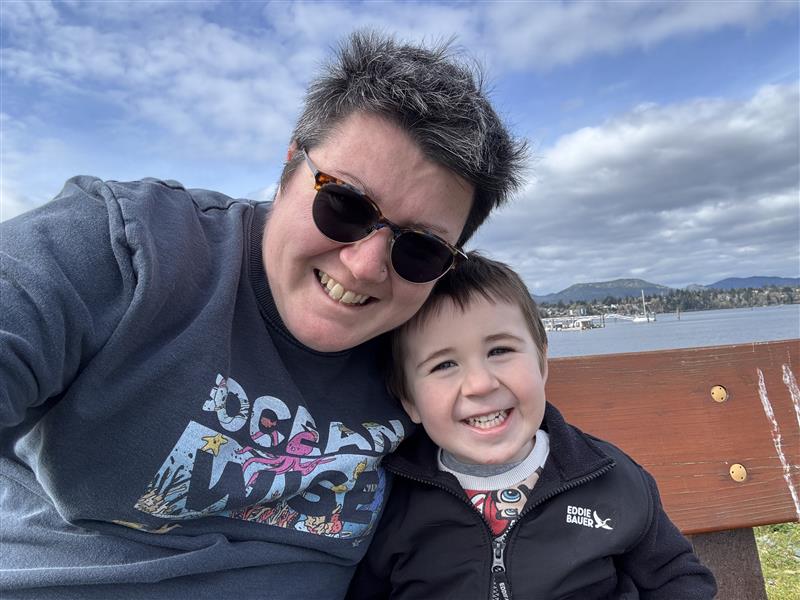
Chloe photographed killer whales from a research vessel while pumping at four months postpartum, balancing fieldwork and motherhood with determination — Credit. C. Robinson
Cognitive load
Whilst the physical demands of pregnancy and recovery are underacknowledged, discussions regarding cognitive changes are almost entirely invisible.
Amelie Laute addresses this with particular honesty: “During the pregnancy and during early breastfeeding I felt like I am much less intelligent. This frustrated and worried me, not knowing if I will ever be able to work on as complicated matters again as before.” The neurological and hormonal changes of pregnancy and postpartum can temporarily affect focus, memory and processing, and not in ways that are predictable or easily timetabled. Not knowing whether you will regain your previous cognitive fluency, while simultaneously being under the kind of performance pressure that characterises early career academia, can be an isolating and frightening experience.
Genyffer vividly recalls the struggle of working through the night to finish her PhD, after caring for her 8 week old baby all day: “I would not get an extension to complete my PhD and would be expelled from the program if I had not finished”. She goes on to say that being both a mother and scientist means “I have to work really hard and extra hours to manage everything. I want to be a present mom, and I also want to excel at work, and that is very demanding…”.
There is rarely formal recognition in most academic environments that the researcher who returns from maternity leave may need a gradual reintegration, more flexibility in deadlines or adjusted expectations for a period. The assumption is typically that the return from leave marks a return to normality, when in reality the body and brain are still very much in transition. And many, like Genyffer, are forced to return to work earlier than they would want due to inflexibility in contracts, funding arrangements and program rules, despite supportive supervisors (in Gennyfer’s case).
What several respondents discovered, often to their genuine surprise, was that the cognitive reorganisation eventually produced unexpected gains. Clare Andvik noted increased efficiency: “The best way to get something done is to have a baby, put them down for a nap, and know you have 1.5 hours before they wake up, otherwise it won’t be done.” Chloe noted that needing to fit everything into defined windows “helped bust some procrastination.” Amelie and Clare both describe working in tight, focused sprints rather than the long, diffuse working days of pre-parenthood.
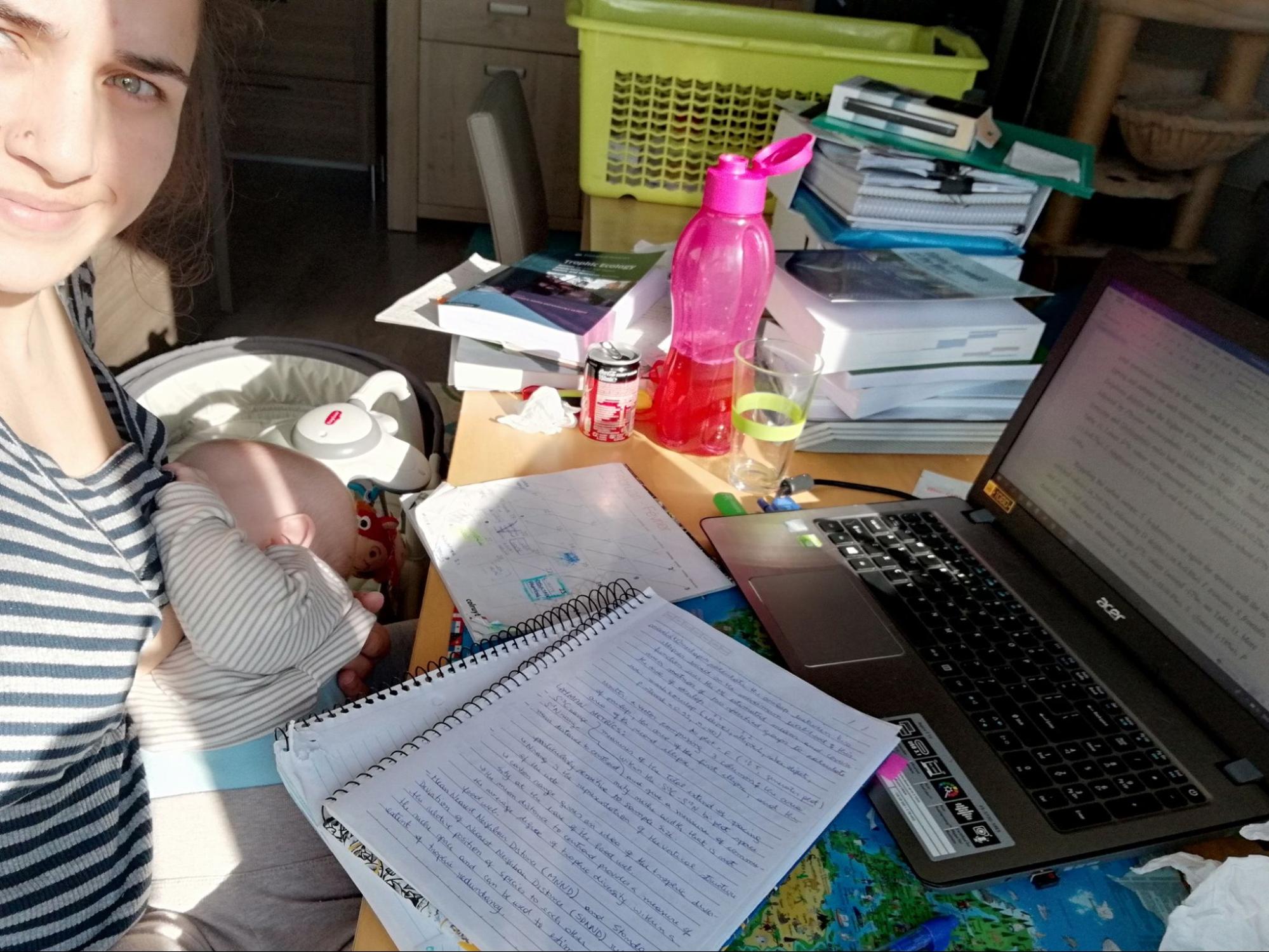
Genyffer Troina pushed through long nights to finish her PhD while caring for her 8-week-old, balancing motherhood and science with relentless dedication — Credit: G. Troina
Partner support
Every respondent in this survey had a supportive partner. This is not a coincidence: it is, at least in part, a selection effect. Those without partner support may have left the field before reaching the stage at which they might respond to this survey. They may not have felt able to participate, or may not have seen their experience reflected in the framing of the questions.
Even within this self-selected group of respondents with supportive partners, the degree and structure of that support varied considerably and those differences shaped outcomes. Amelie and her partner, both students at the time, split childcare strictly 50/50, each taking a half-day with the baby while the other worked. “Splitting up 50/50 between baby and work time was such a good way of life,” she wrote.
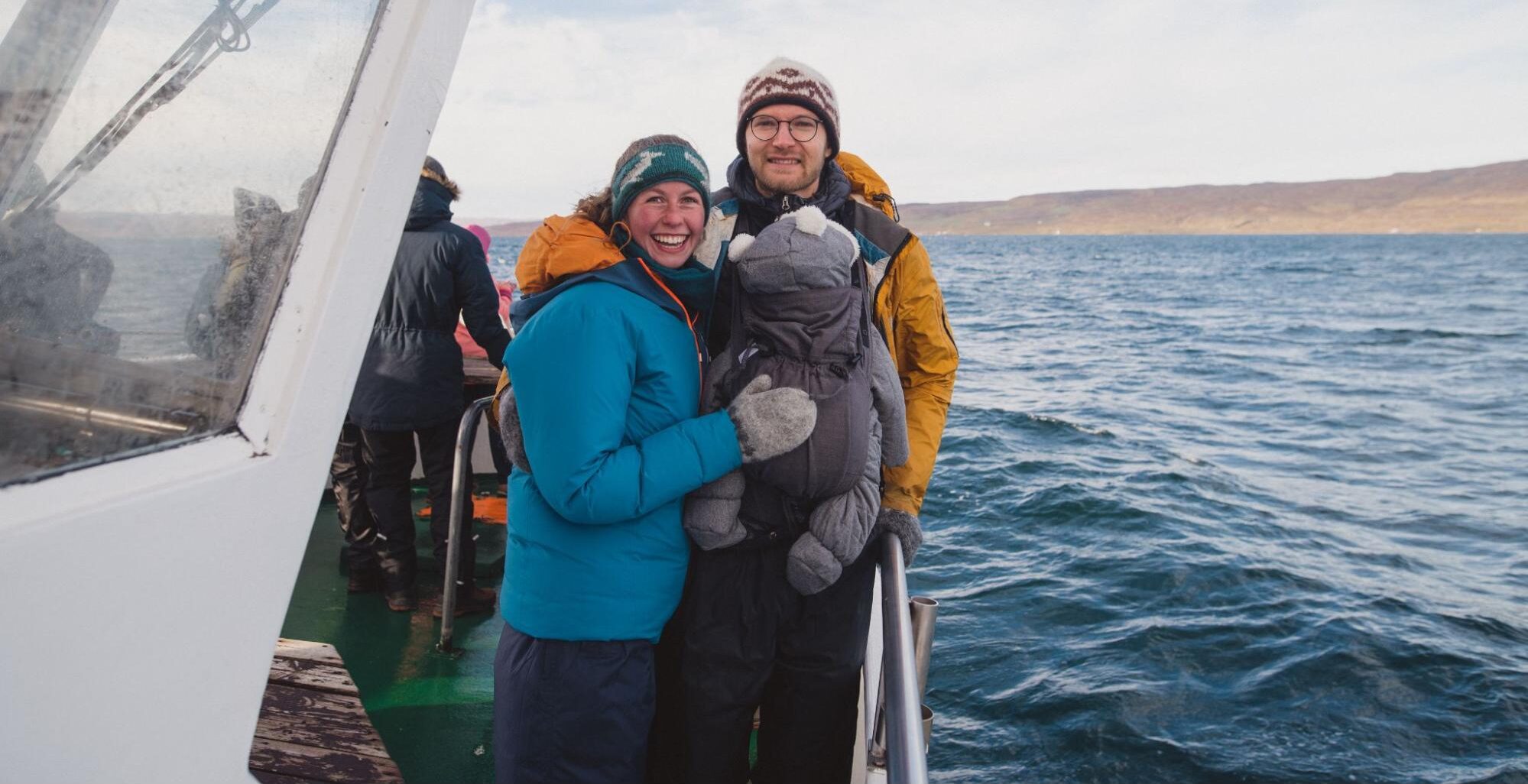 Strong partner support was a key factor in enabling Amelie to remain and succeed in the field — Credit: R. Douglas
Clare points to her “supportive and hands-on husband” as one of the three pillars alongside the Norwegian welfare system and her own organisational strategies that made her PhD viable. Chloe credits her wife as “a huge supporter, especially in those early days, and continues to be a huge reason why I can do what I do.” Genyffer notes that family and financial context matter: “Having a partner outside academia provided financial stability and support that made this possible for me”.
What this underscores is clear: the sustainability of an academic early-career with children depends, in large part, on what happens at home on a set of private domestic arrangements, or the salary of their partner. The researcher who returns from parental leave to an equal-partner household and the researcher who returns to one where the majority of domestic responsibility has defaulted to her are not in equivalent positions, even if their institutional circumstances are identical.
The importance of speaking about it
A smaller but recurring theme across the early-career responses is the significance of visibility, of being able to see, in the professional landscape around you, people who have done what you are trying to do.
Clare, in Norway, draws comfort from the normalcy of what she is navigating: “I am one of many PhDs who have taken maternity leave. It is a nice feeling of community.” For Vanessa, that reassurance was largely absent in her early career, and now, from a more established position, she is actively trying to be what she didn’t have: “I want to show the next generation that having kids does not mean your scientific career is over. There are many of us doing the juggle and that’s OK.”
This is, ultimately, one of the lowest-cost and highest-impact interventions available to anyone in a position of seniority or visibility in the field: simply being open about having children. Mentioning it in talks. Bringing it up in conversations with students. Not performing the fiction that scientific excellence requires the subordination of everything else. The researchers who did not have that kind of role model describe its absence as a genuine professional disadvantage. The researchers who are now deliberately providing it describe it as one of the most meaningful things they do.
What the Early Career parent needs
Taken together, these accounts point to a set of relatively clear if not always simple needs. Supervisors and line managers who respond to pregnancy with support rather than pressure. Institutional cultures that treat parental leave as a normal life event rather than an inconvenience or a signal of diminished commitment, with necessary provisions for contract extensions and a fair living wage. Fieldwork and conference structures that can accommodate the reality that researchers have caregiving responsibilities through flexible timing, shared responsibilities within teams, and clear policies around what pregnant or breastfeeding researchers can and cannot participate in. Evaluation systems that account for the cognitive and temporal demands of early parenthood. And senior researchers who are willing to be visible about their own experiences, so that the next generation does not have to navigate this terrain alone and in silence.
None of this requires a revolution. It requires the professional culture to catch up with the reality that the majority of researchers are already navigating. There are many parents and caregivers in the SMM community, and we hope that by sharing stories the lived reality can be normalized.
We warmly invite anyone who feels comfortable to get in touch with us to share their own stories. Your experiences, whether as fathers, non-birthing partners, single parents, caregivers of family members, researchers who have left the field, or those navigating different cultural and national contexts, are essential to broadening this conversation. Hearing directly from a wider range of voices will help ensure that this series reflects the full diversity of caregiving experiences in science. Please send your stories to communications@marinemammalscience.org
If you feel there are systemic barriers to access, inclusion and equity that should be addressed specifically within our society, please reach out to diversity@marinemammalscience.org
Further reading
Below are a collection of peer-reviewed studies, and non peer-reviewed articles touching on the themes of this article. We hope it helps in adding weight to these shared experiences.
Gender gaps in academia: The role of children | ScienceDirect
The unequal impact of parenthood in academia | Science Advances
Ten simple rules for a mom-friendly Academia | PLOS Computational Biology
The relationship between parenting engagement and academic performance | PMC
The Native American and Indigenous Studies Association (NAISA) and the Global Indigenous Data Alliance.